May 6, 2026
The Narrative
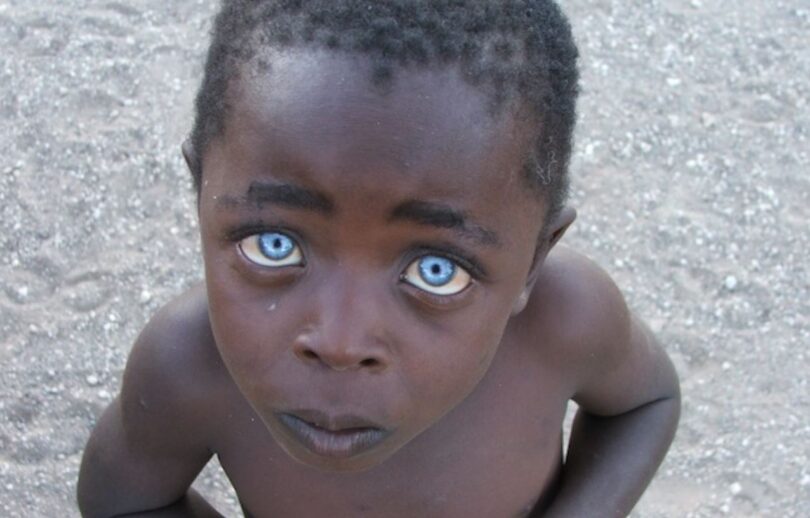
All blue-eyed humans have the same single point mutation from a single common ancestor about 6,000 to 10,000 years ago.-1 Geneticist Tony Frudakis of DNAPrint Genomics Inc., a Sarasota, Florida, was shocked that the mutation happened just once.-1 Although there are about 10 ways to get someone with red hair, scientists found only one way to get someone with blue eyes.
“I would have thought blue eyes arose several times independently.” -1
If blue eyes emerged by a mutation, why did blue eyes persist? Scientists say it is difficult to see how eye color would have an environmental advantage, as skin color does.-1 Some theories suggest that women may have influenced the selection, “the females thought it more exciting to have a male with blue eyes.”-1 Blue eyes emerged by good mutations because originally, all humans had brown eyes (like apes and monkeys only have very dark brown to black eyes-2).
“Originally, we all had brown eyes, but a genetic mutation affecting the OCA2 gene in our chromosomes resulted in the creation of a switch, which literally turned off the ability to produce brown eyes.”-3
The Facts
About 30% of humans have eye colors that are not brown, and about 10% of the global population have blue eyes.-4 Blue eyes are passed by normal reproduction by allele frequencies (gametes) to human offspring at reproduction. Researchers had long implicated the OCA2 gene as exclusively responsible for eye coloration; however, recently, it was discovered that the HERC2 controls the OAC2 gene expression (similar to how lactose tolerance functions as a feedback loop). Together these genes regulate eye coloration in humans by controlling the level of melanin released (melanin is a pigment that also gives hair and skin their hues).-1 The OCA gene on the HERC2 gene “turns off the production of brown eye color and allow(s) blue eyes to shine through.”-1
WORLDWIDE EYE COLOR OF HUMANS
https://worldpopulationreview.com/country-rankings/eye-color-percentage-by-country
Eye color percentages of people worldwide:
Brown eyes: 70%-80%
Blue eyes: 8%-10%
Hazel eyes: 5%
Amber eyes: 5%
Gray eyes: 3%
Green eyes: 2%
Other eye colors: 1%
An alternative view
The empirical (observable) evidence concludes that human eye coloration, like their skin or hair donations, is provided by normal reproduction called allele frequencies. These functions are not carried out by mutational mechanisms but by gametes.-5 There is no substantiating evidence from fossil evidence confirming a “pre-mutational” (fully mappable gene sequence) to prove this mutation ever occurred at all.-6 It is an assumption that it must have happened long ago.
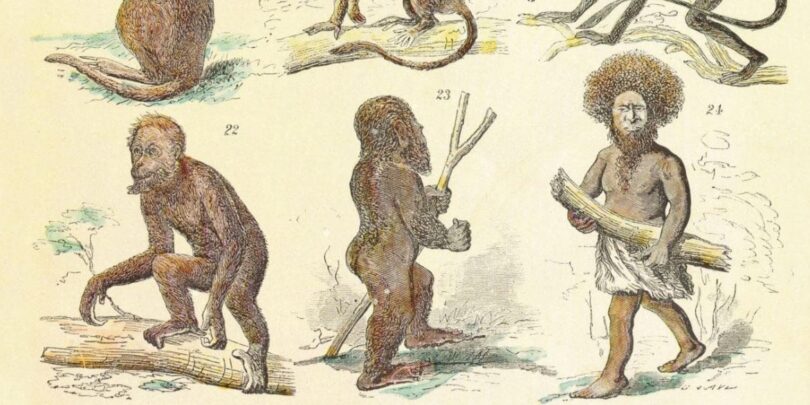
The hypothesis is based on (1) the known genetic materials that drive eye coloration being (2) presumed to have occurred in the deep past. Why? That answer is the circular reasoning of evolution. Essentially, evolution by reproduction and mutation proves traits of evolution in the present. Or, evolution proves evolution: the cause and the effect are the same things! The narrative presumes simple life like single-cell bacteria transmutated into humans over 550 million years, so eye color is not a problem. This assumption is built upon another assumption of humans come from apes. Seeing humans came most recently from apes that only have black-2 (or very dark brown-2) eyes– again, mutation “must” have caused this!
The assumption is plausible, but it is not constructed upon any physical evidence from the past apart from vast genetic fragments and, yes, more assumptions. The best deceptions are 99% fact and 1% lie. Such hereditary ancient mutational assumptions (there are many others like Lactose Tolerance in humans-1) we are at best only 50% fact and 50% presumption.
1- Science, “Don’t It Make Your Brown Eyes Blue?” Feb 2008; Don’t It Make Your Brown Eyes Blue?
2- Caspar, Kai R.; Biggemann, Marco; Geissmann, Thomas; Begall, Sabine, “Ocular pigmentation in humans, great apes, and gibbons is not suggestive of communicative functions” June 2021, Scientific Reports; Ocular pigmentation in humans, great apes, and gibbons are not suggestive of communicative functions – Scientific Reports
3- Newcomb, Tim, “Everyone With Blue Eyes May Descend From a Single Human Ancestor,” May 2023; Everyone With Blue Eyes May Descend From a Single Human Ancestor
4- Eye Color Percentage by Country 2023
6- Curnoe D. Problems with the use of cladistic analysis in palaeoanthropology. Homo. 2003;53(3):225-34. doi: 10.1078/0018-442x-00048. PMID: 12733396. Problems with the use of cladistic analysis in palaeoanthropology – PubMed.