April 30, 2026
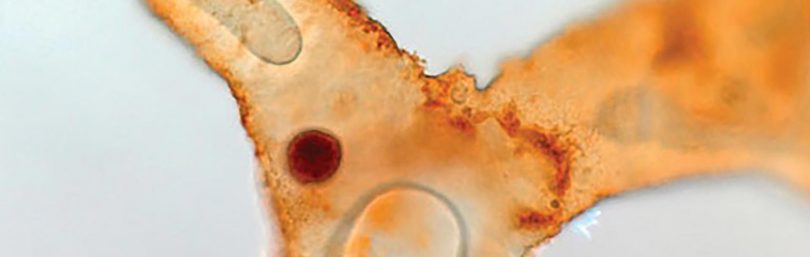
According to the long-held view of fossilization, any dinosaur fossil would be void of any presence of soft tissues, collagen, osteocytes, medullary bone, translucent blood vessels, and even red blood cells— yet they are found in about a third of all dinosaur fossils.
These soft tissues have been documented as authentic in hundreds of dinosaur fossils thought to be at least 65 million years old- others even more than 200 million years old. This evidence challenges the modern evolutionary timescale paradigm directly.
Biologist Mary Schweitzer’s discovery revealed soft tissue structures in dinosaur fossils that had known decay rates that were significantly less than one million years— many with decay rates only in the thousands of years. Carbon dating carries a maximum of about 60,000 years.
This leaves only two logical options: Either the known decay rates of soft tissues were exponentially in error or the dinosaur fossils were not 65 million years old— but both cannot be true.
This is a picture above is of the femur of a t-rex at the dig site— filled with soft tissue proteins.
“The guy looked at it (the t-rex femur samples) and said, ‘Do you realize you’ve got red blood cells in that bone?’ ” Schweitzer remembers. “My colleague brought it back and showed me, and I just got goose bumps, because everyone knows these things don’t last for 65 million years.” Mary Schweitzer, “Schweitzer’s Dangerous Discovery”; http://discovermagazine.com/2006/apr/dinosaur-dna Yeoman, Barry (2006)
If you are familiar with this “dino shocker” we witnessed the scientific community scramble through a series of ‘saves,’ each designed to protect their highly important evolutionary timescale paradigm. First, many denied the samples, calling them biofilms. This was soundly debunked. Others labeled Schweitzer as a radical, even a dreaded “young earth creationist”- she is not. Then came the holy grail- the save: iron. They argued that experiments showed that iron could preserve these tissues for tens or even hundreds of millions of years. Unfortunately, something almost never reported, many samples had no iron particles or iron crystals or residues in the soft tissue samples tested. Turned out that this save was merely wishful thinking.
“We saw no iron particles or crystals associated with all of the soft tissue samples”…“while we saw iron inside partially-degraded tissues and believed that iron might help preserve soft tissue, iron was probably not responsible for all soft-tissue preservation.” A co-author on the Schweitzer paper commented in an interview. -2 Bold and italics are mine.
1- SOFT FLEXIBLE DINOSAUR TISSUES: ARE EVIDENCE OF THOUSANDS OF YEARS
2- “Not all specimens sampled contained preserved soft tissue…” From Article “Preservation frequency of tissue-like structures in vertebrate remains from the upper Campanian of Alberta: Dinosaur Park Formation” Cretaceous Research, Aaron J. van der Reest, Philip J. Currie, May 2020