April 29, 2026
Sickle Cell: “Beneficial Mutation” or Genetic Trade-off?
The sickle cell trait is commonly presented as a textbook example of a beneficial mutation. The standard evolutionary claim is that a germline mutation, thought to have occurred over 7,000 years ago, altered normal red blood cells into a sickle shape and provided a survival advantage against malaria. -1
This example is often used to support the broader claim that mutations can generate advantageous traits that spread through populations by natural selection. However, a closer analysis reveals a more complex picture.
What Is Observed vs. What Is Inferred
What we can directly observe today is:
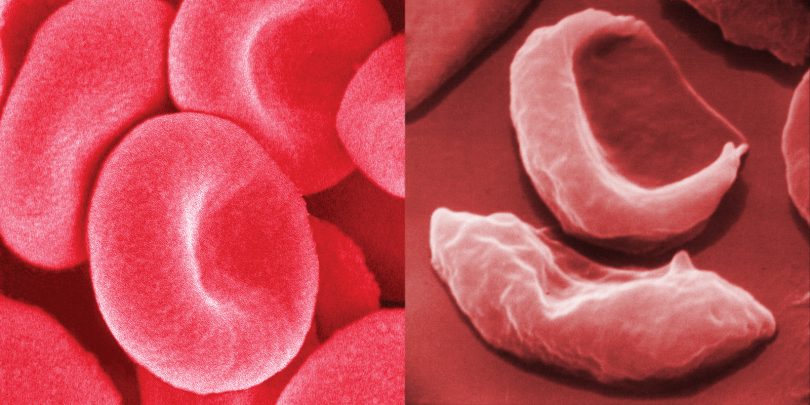
- The presence of both normal (round) and sickle-shaped red blood cells
- The association between sickle cell traits and survival in malaria-endemic regions
- The serious health consequences linked to the condition
What we do not observe is the original mutation event. The claim that this trait emerged from a germline mutation thousands of years ago is inferred, not directly observed. -1
Even though fragments of ancient DNA can sometimes be recovered, they are incomplete and degraded, making it impossible to reconstruct the precise origin of specific mutations.
Natural Selection: Sorting, Not Creating
The spread of the sickle cell trait is attributed to natural selection. In malaria-prone regions, individuals with the trait were more likely to survive, while those without it were more likely to die from infection. -2
As a result, the frequency of the trait increased in those populations.
However, this process demonstrates selection acting on survival, not the creation of new biological systems. Natural selection explains which traits persist, but it does not directly demonstrate how those traits originated.
What the Trait Actually Does
Sickle cell disease alters the structure of red blood cells. Instead of flexible, round cells, affected individuals produce rigid, sickle-shaped cells that can obstruct blood flow and damage tissues.
This is not a neutral change. It is a structural alteration with significant physiological consequences.
The condition is associated with numerous serious complications, including:
- Stroke, organ damage, and chronic anemia
- Severe pain episodes and increased infection risk
- Heart, lung, and kidney disease
- Pregnancy complications and reduced lifespan -3, -4
These are substantial biological costs, not minor side effects.
Trade-off, Not Clear Gain
The sickle cell trait is best understood as a trade-off.
In regions where malaria is prevalent, carrying one copy of the trait can increase survival. However, carrying two copies results in a severe, often life-threatening disease.
This is not a clear example of a mutation producing a net functional improvement. It is a context-dependent advantage linked to an underlying dysfunction.
Preexisting Capacity
Red blood cells can adopt a sickle-like shape under certain stress conditions, such as low oxygen levels or extreme exertion.
This suggests that the structural capacity for such a change may already exist within the system, and the mutation stabilizes or amplifies this condition rather than creating something entirely new.
The Evidence Gap
The claim that the sickle cell trait originated from a specific mutation event thousands of years ago cannot be directly substantiated.
We can identify the gene and its effects today, but we cannot observe:
- when the mutation first occurred
- the genetic state prior to the mutation
- or the exact conditions of its emergence
These conclusions rely on inference rather than direct empirical observation. -1
The Larger Pattern
The sickle cell example reflects a broader pattern observed in genetics:
- Mutations alter existing biological systems
- These alterations often introduce dysfunction
- Any apparent benefit is typically conditional and accompanied by trade-offs
Rather than demonstrating the creation of new biological systems, this example shows how changes to existing systems can produce mixed outcomes.
Conclusion
The sickle cell trait is often presented as strong evidence for beneficial mutation and evolutionary progress. A closer analysis shows:
- The spread of the trait is explained by natural selection acting on survival, not by the creation of new systems -2
- The underlying change produces significant dysfunction alongside limited, context-dependent benefit -3, -4
- The origin of the mutation is inferred, not directly observed -1
- The trait reflects modification of an existing system, not the emergence of a new one
At minimum, this example does not demonstrate the kind of sustained, constructive biological innovation often claimed.
It demonstrates selection acting on variation, where survival can favor traits that carry significant biological cost.
1. Esoh, Kevin; Wonkam, Ambroise.
Evolutionary history of sickle-cell mutation: implications for global genetic medicine.
Human Molecular Genetics, Volume 30, Issue R1, March 2021, Pages R119–R128.
https://academic.oup.com/hmg/article/30/R1/R119/6103809
2. Serjeant, G. R.
The natural history of sickle cell disease.
Cold Spring Harbor Perspectives in Medicine, 2013;3(10):a011783.
https://www.ncbi.nlm.nih.gov/pmc/articles/PMC3784812/
3. Miller, A. C.; Gladwin, M. T.
Pulmonary complications of sickle cell disease.
American Journal of Respiratory and Critical Care Medicine, 2012;185(11):1154–1165.
https://www.ncbi.nlm.nih.gov/pmc/articles/PMC3373067/
4. Xu, J. Z.; Thein, S. L.
The carrier state for sickle cell disease is not completely harmless.
Haematologica, 2019;104(6):1106–1111.
https://www.ncbi.nlm.nih.gov/pmc/articles/PMC6545856/